
Sicbo rules can look intimidating the first time you open the betting grid. There are dozens of boxes, payouts ranging from even money all the way to 180:1, and a round that begins and ends in well under a minute. In practice, this is one of the most approachable games in any casino lobby, including the table game selection at tài xỉu, because every single wager comes down to one question: what will three dice show? Learn the structure once and the entire layout becomes readable at a glance.
What Sicbo Is and Why the Game Is Simpler Than It Looks
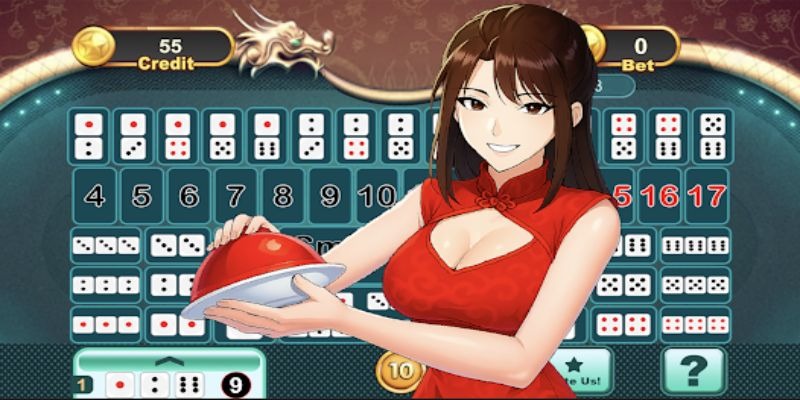
A complete breakdown of how the three dice game works under standard Sicbo rules
Before looking at a single payout figure, it helps to understand what actually happens between the shaker closing and the chips being cleared.
Tài xỉu , also written as Tai Sai, Dai Siu or “big and small”, is an ancient Chinese dice game that has been running on casino floors for centuries and online for the last two decades. Three dice are placed in a shaker or a transparent electronic dome, the dealer or machine agitates them, and the result is revealed. Every bet on the table is then settled at the same moment. There is no drawing, no doubling, no dealer decision, and no strategy to apply after your chips have landed.
That structure is precisely why Sicbo rules can be absorbed in a single sitting, unlike blackjack or baccarat variants where in-play decisions change the mathematics. Your only real skill is choosing where to place chips before the countdown ends. Everything else is fixed probability, and all of it is published on the table itself.
Here is what a new player genuinely needs to know on day one:
- Three dice, one result per round. The combined total always falls somewhere between 3 and 18.
- Bets are locked before the shake. Once the timer expires there are no changes, no cash out and no insurance.
- Every wager is independent. The previous ten rounds have zero influence on the eleventh.
- Payouts range enormously. Even money bets sit beside 180:1 long shots on the same grid.
- Round pace is fast. Online tables typically resolve in 30 to 45 seconds, so spend per hour is high.
- The grid never changes. Once you can read one table, you can read all of them.
The layout you will see on a tài xỉu Sicbo table follows the standard Macau arrangement: even money bets along the outside edges, total sum boxes across the middle, and the high payout triples and doubles grouped together. Because the physical layout mirrors the mathematics, Sicbo rules effectively teach themselves once you notice that the boxes furthest from the centre are also the safest ones.
The Core Bet Types Behind Sicbo Rules
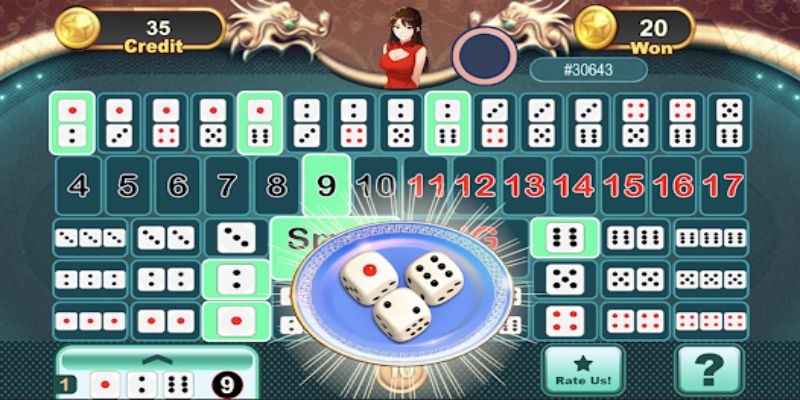
A visual guide to the betting grid and every wagering option covered by Sicbo rules
Now that the sequence of a round is clear, the next step is understanding what each area of the grid actually represents.
There are roughly six families of wagers, and almost all operators use the same six with only minor naming differences.
Small and Big, the 4 to 10 and 11 to 17 split
These are the two even money anchors of the game. Small wins when the three dice total between 4 and 10, while Big wins when the total lands between 11 and 17. The critical exception is that any triple, meaning three matching dice, loses both bets automatically. That single carve out is exactly where the house takes its margin, and it explains why the two most popular bets on the table are still not a coin flip.
Odd and Even
Functionally identical in risk profile to Small and Big, these bets simply ask whether the combined total is an odd or an even number. Triples again void the wager on most tables. Players who prefer a slow, low variance session often alternate between these boxes and the Small and Big boxes, since both sit at the lowest available house edge.
Specific Triple, Any Triple and Specific Double
This is the high risk corner of the grid. A Specific Triple asks for an exact set, three fours for example, and pays a headline 180:1. Any Triple covers all six possible sets at 30:1. A Specific Double requires at least two dice showing a chosen number and pays 10:1. These boxes generate the dramatic moments that make the game memorable, and they are also where inexperienced players lose bankrolls fastest.
Total Sum bets from 4 to 17
Each individual total between 4 and 17 has its own box and its own payout, scaled to how many dice combinations can produce it. A total of 10 or 11 is the most common outcome and pays modestly, while a total of 4 or 17 is the rarest and pays the most. Understanding this scale is the single most useful thing a beginner can take from Sicbo rules, because it shows exactly how payout size and probability are tied together.
Single Number and Two Dice Combination bets
A Single Number bet wins if your chosen face appears on at least one die, paying more if it appears twice or three times. A Two Dice Combination bet requires two specified different numbers, say a 2 and a 5, to appear among the three dice. The combination bet is quietly one of the better value wagers on the entire table, though it rarely gets the attention the triples do. Both are offered on RNG and live dealer tables at tài xỉu under identical conditions.
Payout and House Edge Reference for Every Bet
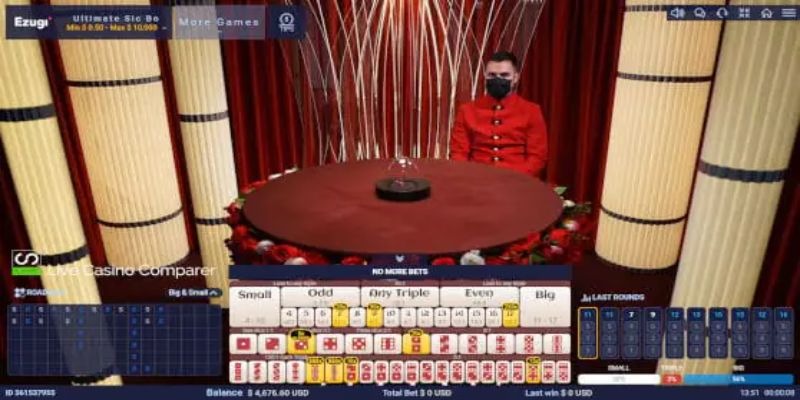
A payout and probability chart showing the odds behind each wager permitted by Sicbo rules
Understanding what each bet does is only half the picture. The other half is knowing what it costs you over time.
The table below summarises the standard payout schedule used on most Macau style layouts, along with the theoretical house edge for each option. These figures are the practical core of Sicbo rules, because they tell you where the mathematics is closest to neutral and where it is heavily tilted.
| Bet type | Payout | House edge | Probability |
| Small / Big | 1:1 | 2.78% | 48.61% |
| Odd / Even | 1:1 | 2.78% | 48.61% |
| Two dice combination | 6:1 | 2.78% | 13.89% |
| Single number | 1:1 / 2:1 / 3:1 | 7.87% | 34.72% |
| Total 10 or 11 | 6:1 | 12.50% | 12.50% |
| Total 7 or 14 | 12:1 | 9.72% | 6.94% |
| Total 4 or 17 | 60:1 | 15.28% | 1.39% |
| Any triple | 30:1 | 13.89% | 2.78% |
| Specific double | 10:1 | 18.52% | 7.41% |
| Specific triple | 180:1 | 16.20% | 0.46% |
Read down the right hand column and a clear pattern emerges. The three cheapest wagers, namely Small and Big, Odd and Even, and the two dice combination, all sit at 2.78%. That is competitive with baccarat and noticeably better than American roulette. Every other box on the grid costs significantly more, and the most eye catching payouts carry edges between 13% and 19%.
This is why experienced players treat Sicbo rules as a filtering exercise rather than a system. No betting progression, roadmap pattern or streak reading method alters these percentages, because each round is statistically independent. What you can control is bet selection, stake size and how many rounds you play in a session.
One practical caution: payout schedules are not universal. Some operators pay 150:1 on a specific triple instead of 180:1, or 50:1 on a total of 4, which changes the edge materially. Always open the game info panel and confirm the schedule before your first stake. On tài xỉu tables this sits directly beside the betting grid, so the check takes only a few seconds.
Finally, treat pace as part of the cost. A game resolving every 40 seconds can produce 90 rounds an hour, which means even a low edge approach churns through a bankroll faster than a slower table game would. Applying Sicbo rules well means setting a session limit and a unit size before you sit down, not after the first losing streak. Most players find that anchoring on the 2.78% bets and treating the high payout boxes as occasional small stake entertainment produces a far longer and more enjoyable session than spreading chips across the whole grid.
>> Read more: Mẹo đánh bài online
Conclusion
Sicbo rules reward the players who take twenty minutes to understand the grid before placing a single chip on it. The game asks nothing complicated of you, just three dice, one outcome and instant settlement, but the gap between the best and worst bets on the table is enormous, running from a 2.78% edge on the even money boxes to well over 18% on a specific double. Know which side of that gap you are betting on, confirm the payout schedule on whichever table you join, and set your limits in advance. With that foundation in place, the dice tables at tài xỉu become a genuinely readable game instead of a wall of unfamiliar boxes, and readable is exactly where good decisions start.